
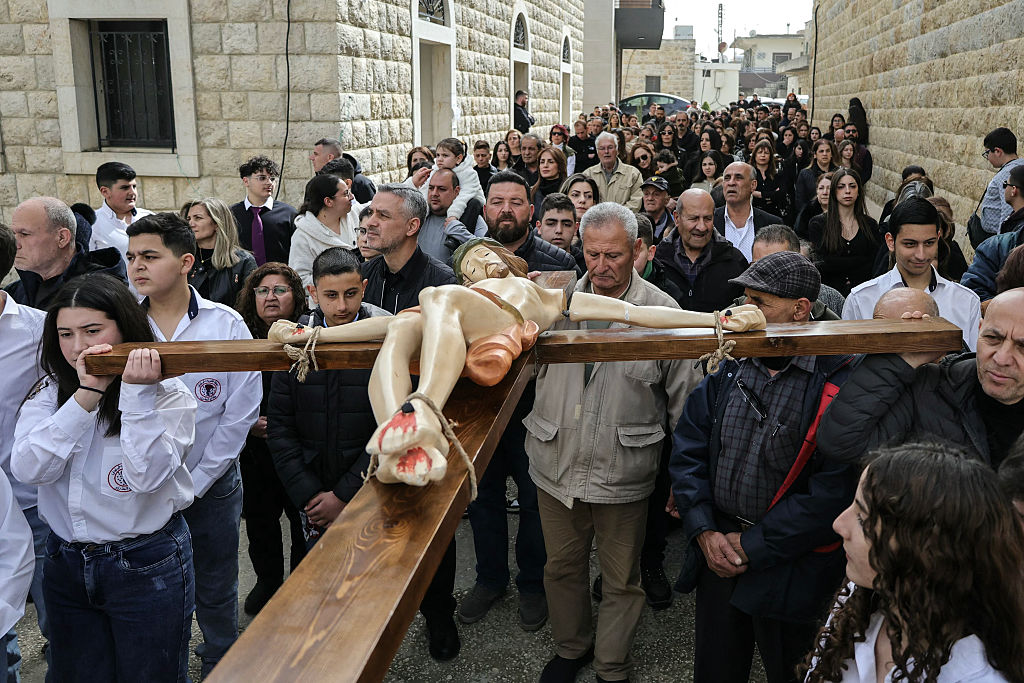
It was clear that Netanyahu’s story was intended to create confessional strife in Lebanon by singling out Christian communities as privileged and sowing national discord, writes Tracy Chamoun. [GETTY]
The territory Israel has occupied in southern Lebanon since 2 March includes several Christian villages. Additional Christian villages within the security zone declared by Israel have been eradicated through deliberate demolitions. Since the war began, these surviving Christian villages have been under siege. They have endured Israeli shelling, airstrikes, displacement, and infrastructure damage, yet most have remained inhabited despite numerous Israeli evacuation orders.
Many residents chose to stay in their villages to protect their homes, churches, and farmland, despite harsh conditions. They are barred from leaving to seek treatment or obtain essential supplies without prior approval from “the Mechanism Committee,” the supervisory body established after the war ended in 2024. Essentially, they must obtain authorisation from the Israeli army before they can do anything.
Today, following the announcement of successive ceasefires, Hezbollah has engaged in fewer acts of resistance. Yet the Israeli army continues to refuse to withdraw, even from the designated pilot zones. Furthermore, civilian movement remains restricted across most of Southern Lebanon, while airstrikes, shelling, and widespread demolition to prevent recovery continue daily.
Under threat
The oppression of the occupying Israeli forces continues to affect Christian towns. When asked about life in Jdeidat Marjeyoun, one of the largest Christian cities just on the border of the security zone, a female citizen who wishes to remain anonymous for fear of Israeli retaliation, as she occupies an official position in the village, said: “The Lebanese people of the South have been under constant attack and the villages that have been spared complete destruction have had to live under constant fear and humiliation.”
Last week, mayors in several predominantly Christian towns in the Marjayoun district received text messages from the Israeli side warning them not to allow displaced residents to return to their homes. The same woman from Jdeidet Marjeyoun said that “when the municipality receives voice messages from the IDF commanding the Christian towns to forbid any non-resident or those who used to work and live in these villages and towns from returning, the towns move quickly to ask any Lebanese who has come back to leave immediately. This is a very difficult and devastating decision for the Municipality to make.”
The messages are becoming not only more frequent but also more direct in their demands for compliance; otherwise, the consequences will be dire for the townspeople. These messages leave the Christian inhabitants in a “constant state of anxiety and tension,” since they carry a serious tone that tells them to comply or risk becoming targets.
It must be understood that most of these towns are not purely Christian and have many Sunni and Shia inhabitants, who occupied the land even before the Christians arrived.
In this way, this Israeli approach to the Christian communities can only be described as a double-edged sword. While they claim to protect the Christians, these people are also being pressured and subordinated. That is why, when the Israeli Prime Minister, Benjamin Netanyahu, claimed a few days ago that some Christian villages in Lebanon had asked to be annexed by Israel, it came as a huge shock to all the Lebanese and especially to the inhabitants of these Christian villages, who expressed outrage.
In his statement, Netanyahu said: “There are Christian villages in Lebanon, some of which have actually asked to be annexed to Israel because we are protecting them from Hezbollah fanatics who want to kill them, and we are doing the same for Christians everywhere.” He added that not only Christians but also Druze, Sunni Muslims, and some Shiites seek his protection.
Netanyahu’s declarations are being viewed in Lebanon as false and provocative. Not only has Hezbollah never attacked any Christian village, but after Netanyahu’s remarks, several Christian villages issued statements refuting his claims and insisting that their future lies solely with the Lebanese state. They dismissed his comments as untrue.
Hanna al-Amil, the head of the majority-Christian municipality of Rmeish, said that the residents take pride in their national identity and regard Lebanon as their final and permanent homeland. They reject any attempt to twist their position or exploit their suffering in the service of agendas that have nothing to do with them.
It was clear that Netanyahu’s story was intended to create confessional strife in Lebanon by singling out Christian communities as privileged and sowing national discord. However, if we consider that what Netanyahu said was on Fox News, and in the context of the upcoming Israeli elections, we can deduce that these comments were targeted at the Jewish diaspora in the United States and the Republican base.
By giving a religious protectionist slant to Israel’s presence in Lebanon, Netanyahu was conveying a message to that base, as well as to the Christian Zionists among them, that Israel is acting as the guarantor of the safety of the Christian “faith” in Lebanon.
Framework agreement
In the Lebanese context, Netanyahu’s statements came amid ongoing negotiations and the implementation of the framework agreement. By saying that the Christian villages are asking to be annexed by Israel, he reinforces the Israeli narrative that Lebanon is a failed state, unable to protect its citizens who are under Hezbollah’s control. This also justifies Israel’s invasion.
Coinciding with Netanyahu’s statements, the Israeli Defence Minister Yisrael Katz questioned the Lebanese army’s willingness or ability to act against Hezbollah, also reinforcing the Israeli view of Lebanon: that with no central government representing all Lebanese, Israel is justified in conducting direct negotiations with the local sects, even if this further undermines Lebanese sovereignty.
Netanyahu’s comments also came at a time when the framework agreement signed in Washington under US auspices is not yet being implemented. The Israeli side is attempting to blame this delay on the Lebanese government’s lack of authority over all of the territory and on the unpreparedness of the Lebanese army to assume its role in disarming Hezbollah.
In fact, the delays in the implementation of the framework agreement stem from the Israeli side, which is still refusing to hand over two small areas to the Lebanese Army.
When listening to such remarks by the Israeli Prime Minister, it is important to keep in mind that for the Lebanese people, there is a big difference between not approving of Hezbollah’s actions or weapons outside state control and asking to be annexed by Israel.
Even if, for the first time in history, the Lebanese people are considering a peace agreement with Israel, this does not mean that they do not regard Israel as an enemy of their country. Suffice it to say that Benjamin Netanyahu’s electoral ploy and his attempt to sow internal discord in Lebanon failed and backfired on him.
Tracy Chamoun is the former Lebanese Ambassador to the Hashemite Kingdom of Jordan. She is also a political analyst, award-winning author, and writer.
Follow Tracy on Instagram: @tracy.chamoun
Have questions or comments? Email us at: ed***************@*****ab.com
Opinions expressed in this article remain those of the author and do not necessarily represent those of The New Arab, its editorial board or staff.
