
If you don’t speak the language, you don’t exist: the silent struggle of Morocco’s Amazigh women.
In Morocco today, being a woman is enough to make the world turn its back on you. But being an Amazigh woman? That makes you almost invisible. At this intersection, where gender and ethnic identity combine, marginalization deepens, and discrimination becomes multilayered.
In rural Morocco, Amazigh women still carry water, feed goats, run farms, raise children, bury elders, and do it all while navigating a country that refuses to listen to them. Tamazight – the standardized Amazigh language merging the Central Atlas, Tashelhit, and Tarifit dialects – has been officially recognized in the Moroccan Constitution since 2011. But in courtrooms, hospitals, police stations, even classrooms, Arabic remains the only tongue.
This means that for the millions of Amazigh women across Morocco, justice is conditional. Conditional on learning a language they never spoke. Conditional on translating their trauma. Conditional on erasing their heritage. (Official figures state there are 10 million Amazigh in Morocco, over half of whom are women, but NGOs on the ground believe the actual number is much higher.)
‘We told Amazigh women: “You are not alone. And you’re not powerless.”’
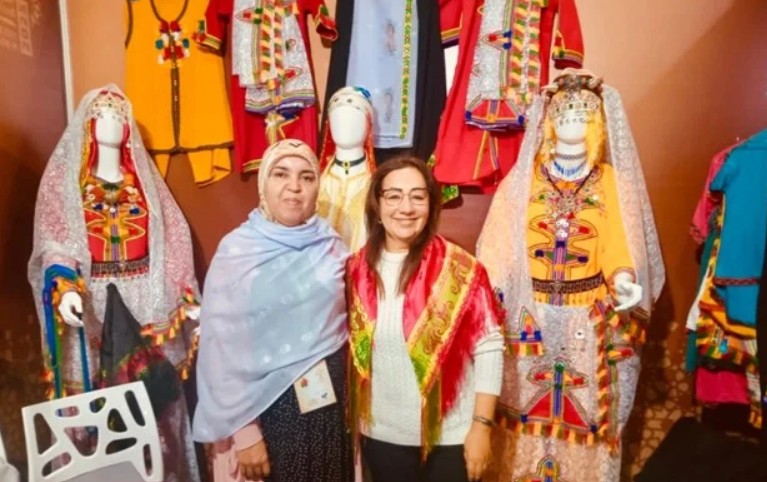
‘Amazigh’ means ‘Free Person.’ It refers to a millennia-old culture rooted in North Africa, traditionally based on matriarchal structures where women have played central roles in leading families and communities. However, with the growing dominance of Arabic in past centuries, Amazigh communities, particularly women, were gradually marginalized, losing their status within their communities and eventually their self-esteem.
Why We Started Speaking, Together
‘I was six years old, full of enthusiasm, but also completely overwhelmed. When I arrived at school for the first time, I was terrified to discover that the language spoken there wasn’t my own. In the playground, dialectal Arabic; in the classroom, classical Arabic. And I only knew Amazigh. It was the language of my home, of my heart, of who I was.’
‘That night, I couldn’t sleep. Dozens of questions swirled through my mind. I didn’t want to go back. The next day, during recess, I was left alone, unable to communicate. And that’s when it hit me: they were forcing me to leave my mother tongue behind, as if they were asking me to give up a part of myself. It’s a pain I’ve never forgotten.’
‘But when I returned home that day, it was my mother who gave me the strength to carry on. She did everything she could to make sure I didn’t drop out of school, despite the obstacles. Thanks to her, I persevered. That first week of school is still etched in my memory. It’s as a reminder of what it means to be an Amazigh child in a system that doesn’t recognize your language or your identity,’ confides Amina Zioual, Founder and President of La Voix de la Femme Amazighe, (Voice of the Amazigh Woman) speaking with MRG for this piece.
In 2009, a handful of Moroccan women of Amazigh descent had had enough. They were teachers, civil society workers, and daughters of Amazigh women. They knew their rights were being stolen but they didn’t have the tools to say so. They decided to found La Voix de la Femme Amazighe.
Their goal wasn’t to ask for inclusion but to demand it as their birthright.
In the beginning, their work was simple but radical: ‘we brought in Amazigh-speaking lawyers to teach women what their rights were. Not in theory, in Tamazight. We showed up in towns where no NGO had set foot. We told Amazigh women: “You are not alone. And you’re not powerless”’, shares Zioual, founder and president of the NGO.
And slowly, things started to change. A woman who didn’t know how to write her name learned how to read a birth certificate. A widow who thought land rights belonged to men learned she could go to court, and win. A teenage girl on the brink of an early marriage found the words to say no. A woman ran as a candidate at her municipality, won and became a member of her municipality’s board.
When the law says yes, but the system says no
Morocco loves to point to Article 5 of its Constitution, which enshrines Tamazight as a national language. ‘It looks great on paper. But that’s where it stops,’ shares Zioual with frustration.
Integration is progressing extremely slowly, with no substantial reforms such as the inclusion of Amazigh in public institutions. Court clerks are not trained in Tamazight. There are rarely interpreters. Legal forms exist only in Arabic. Even the police often dismiss Amazigh speakers as ‘backward’ or ‘uneducated’, as if fluency in Arabic is a prerequisite for dignity. The state built the foundations for inclusion, but kept the door locked.
‘We’ve had meetings. Written reports. Hosted capacity building sessions. Yet still, many women in remote areas as well as in big cities remain unaware of their rights, as if they don’t have a voice. As if they are second grade citizens,’ says Zioual.
What the MACS Programme made possible
‘The MACS Programme gave us more than funding, it gave us reach. With [MRG’s] support, we conducted research on underage marriage, launched legal literacy programmes and mobilized local communities across Morocco’, explains Zioual.
‘But our proudest achievement? Ensuring our voices were heard through the submission of a Memorandum calling for change in the judicial system regarding the situation of Amazigh Women. We also produced a research report highlighting how the judicial system continues to discriminate against Amazigh women, which we shared with the Minister of Justice and all relevant state institutions involved in the implementation of Law 26/16, which mandates the integration of the Amazigh language across all public institutions in Morocco.’
Amazigh voices will not go quiet
Empowerment doesn’t come through slogans. It comes through access. There is still much to do to empower Amazigh women to live up to their full potential. Laws and policies are important in theory, but real implementation on the ground is urgently needed.
Amazigh identities, values, and heritage, shaping who they are and forming an integral part of the Moroccan identity, should not only be respected but actively safeguarded.
Amazigh women are not a case study. They are not a statistic. They are the daughters of Moroccan women who survived colonization, drought, war, and forced Arabization, and still remembered the songs. They are still surviving.
They speak Tamazight because it is their birthright. And they fight because no woman should ever be told her rights are out of reach because she was born speaking the ‘wrong’ language. Or her language is less than another. Amazigh are the guardians of a millennia-old legacy. This legacy must be protected and valued as a vital pillar of Moroccan identity.
