

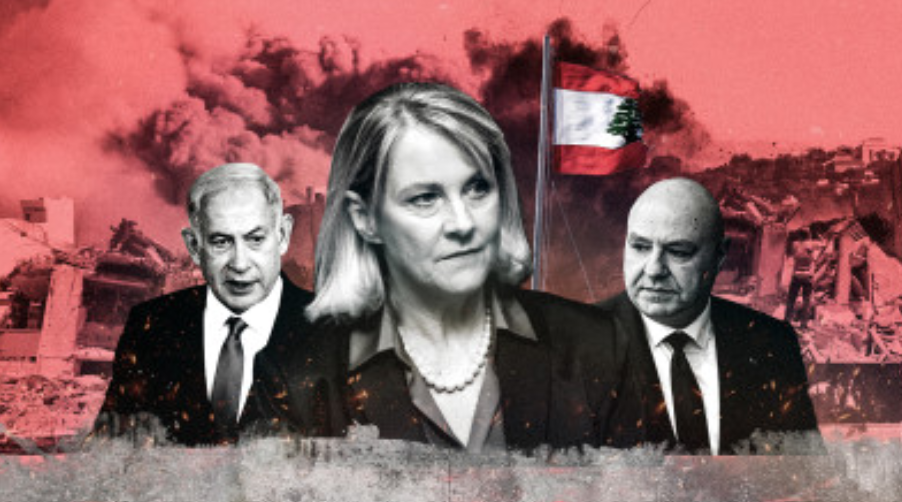
Few names carry as much political weight in Lebanon as Chamoun. For generations, the family has occupied a prominent place in the country’s political life, from former president Camille Chamoun to National Liberal Party leader Dany Chamoun, whose assassination in 1990 remains one of the most infamous political killings of Lebanon’s civil war era.
Tracy Chamoun has spent much of her life navigating that legacy. A former ambassador to Jordan, founder of the Liberal Democrats Party of Lebanon, and the second woman ever to seek Lebanon’s presidency, Chamoun has long attempted to carve out a political identity distinct from both the traditional parties that dominate Lebanese politics and the regional powers competing for influence over the country.
Though a critic of Hezbollah and a supporter of institutional reform, Chamoun is equally vocal against the Israeli military aggression in Lebanon and the international community’s failure to defend Lebanese sovereignty.
As Chamoun spoke to The New Arab, Lebanon is once again grappling with Israeli military assaults and the continued occupation and destruction of large parts of its southern territory. Direct talks involving Lebanon, Israel and the United States are underway, even as Israeli forces continued to pound Lebanon from the air and on the ground.
Since the latest phase of the war began on 2 March, more than one million people have been displaced by Israeli attacks and evacuation threats, while at least 3,690 people have been killed as of 10 June. Debate has also intensified over Hezbollah’s future role, the Lebanese army and the country’s long-delayed national defence strategy.
Throughout the conversation, Chamoun repeatedly returns to one theme: sovereignty. Whether discussing Israeli operations, Hezbollah’s weapons, foreign mediation or Lebanon’s fractured political system, she argues that the country’s greatest challenge remains its inability to exercise full control over its own territory and decision-making.
Chamoun also spoke about the ongoing negotiations with Israel, the destruction of Christian villages in south Lebanon, Hezbollah’s future, the regional confrontation involving Iran and the United States, and what she believes Lebanon’s leadership should have done differently during the latest war.
Below is an edited transcript of TNA’s conversation with Tracy Chamoun.


Lebanon and Israel are pursuing both political and military tracks simultaneously, with further meetings reportedly planned in Washington later this month. What does Lebanon stand to gain from these talks?
It’s very difficult to negotiate when Israel has the upper hand. We were fortunate that President Donald Trump intervened when Israel was reportedly preparing a much larger military operation in Lebanon after launching its attack on 8 April, when it killed about 300 Lebanese people. Instead, attention shifted towards talks that President Joseph Aoun had already been advocating.
The problem is that Lebanon enters these negotiations from a position of weakness. We’re dealing with an invading force and potentially an occupying force, while the conditions governing the ceasefire are largely not in Lebanon’s hands.
That said, the talks remain important. Lebanon has largely disappeared from the international radar, which has allowed Israel to continue military operations, expand a so-called security zone and carry out widespread destruction.
Negotiations bring attention back to Lebanon and also provide a framework for re-establishing international boundaries and defining the discussion within a legal and diplomatic context.
What would be the best possible outcome for Lebanon from these negotiations?
The first step would be forcing Israel to abide by the ceasefire and stop the carnage. The current arrangement, signed under US auspices, creates a double standard. Lebanon is expected to respect the ceasefire, while Israel has effectively reserved for itself the right to strike whenever it chooses.
So we have an unconscionable situation where one side is observing a ceasefire, and the other isn’t. That’s not really a ceasefire, and it really presents Lebanon with this double standard where what is okay for Israel is not okay for anybody else.
We saw that again recently when Israel carried out multiple strikes in south Lebanon after negotiations in Washington, carrying out an assassination where they also killed a 17-year-old girl with her father. Hezbollah later responded, but it was not the side that initiated the violations.
There have been reports about American proposals involving a special Lebanese military force tasked with disarming Hezbollah. How do you view that idea?
Personally, I see it as very dangerous because it mirrors the Israeli model of Palestinians policing Palestinians in the occupied West Bank by the Palestinian Authority. In Lebanon, this would create serious confessional problems because any force created specifically for that purpose would inevitably raise questions about representation and legitimacy. Instead of strengthening national unity, it risks deepening divisions between communities.
It’s also going to be a force that doesn’t contain the national requirement of representation from every community, because you cannot realistically ask a member of the Shia community to go ahead and target and kill their own community—that would be fratricide.
So it’s going to be an organisation which is confessional in essence and is just going to create a further divide among the different confessions in Lebanon and possibly exacerbate the violence and create more violence among the communities.
Many people associate southern Lebanon with Hezbollah. But there are also Christian communities there that have been affected by the conflict. What has been the impact on those villages?
The Christian villages in the south have been very seriously affected. First of all, they’re caught in the crossfire to a certain extent between Hezbollah and Israeli forces. Secondly, they’ve been targeted by Israeli attacks, through airstrikes, targeted assassinations and demolitions.
Some villages directly on the border have been flattened, while others have suffered through infrastructure damage, lack of access to supplies and the destruction of water and solar systems that communities rely on.
What many people don’t realise is that many villages in south Lebanon are mixed. They have Christian and Shia populations living side by side, and the destruction by Israel hasn’t distinguished between communities.
You also have places of enormous historical and religious significance, such as the ancient Greek Catholic Melkite monastery in Yaroun, which was demolished. Airstrikes didn’t hit it. It was demolished by bulldozers and explosives. So this was a very intentional demolition. We also saw Israeli soldiers disfigure a figure of Christ, so this is very intentional.
There’s also Qana, associated with Jesus’ first miracle and a pilgrimage site. It has been heavily targeted and has suffered repeated destruction over the decades by Israel, with many people killed there. So the Christian villages are certainly not being spared, and it is shocking to some Lebanese when they see some Christians supporting Israel, despite all this.
There is no differentiation. When Israel has its agenda, it’s like a bulldozer running over everything in its path.


